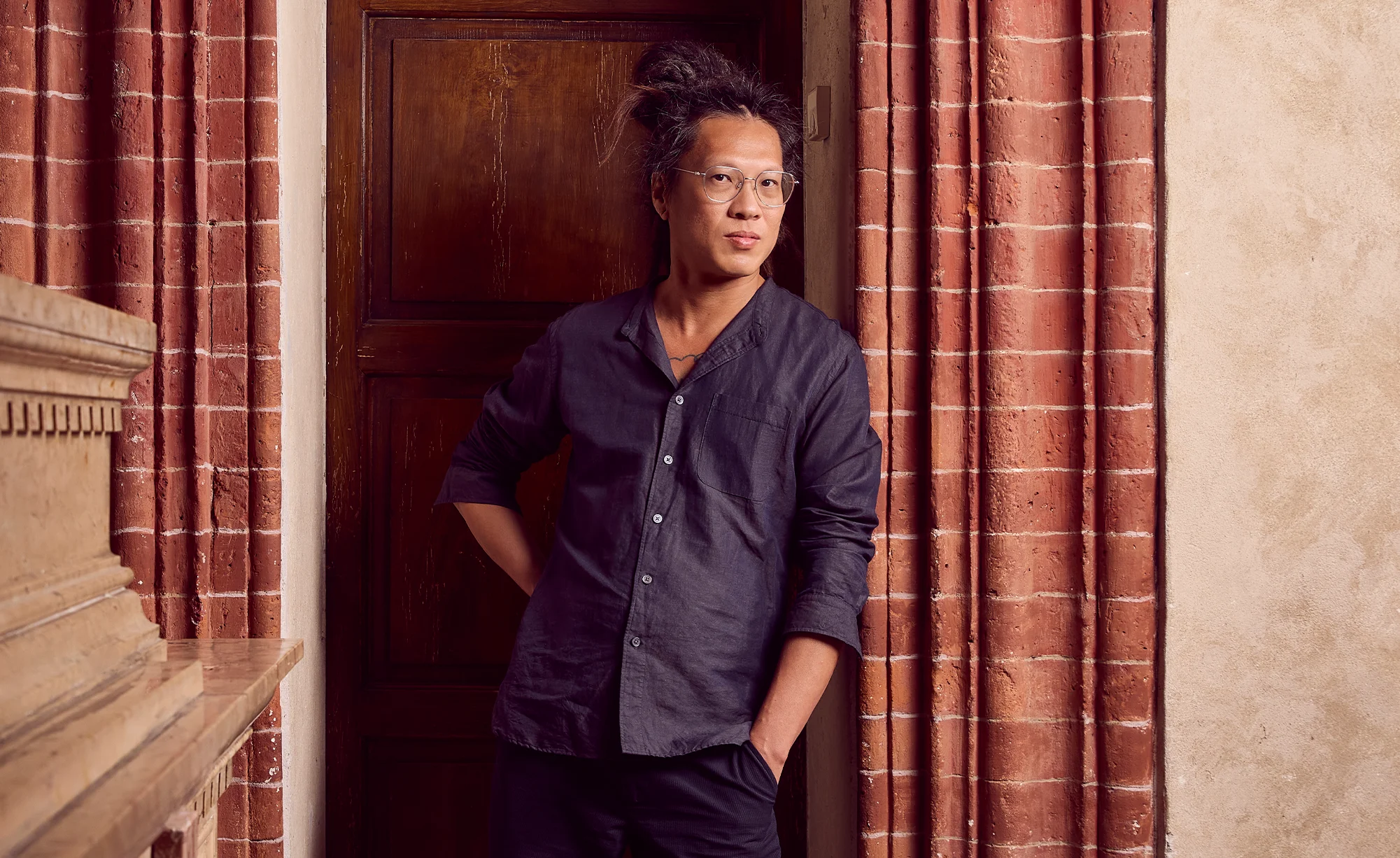
The interdisciplinary studio’s creative and design directors on how the role of design has evolved in Singapore, why clients are more willing to take risks on bolder choices, and the rigor behind their work across narrative, imagery, and space.


Up next in our Singapore Design in Focus series, we speak with Mervin Tan, Creative Director, and Cheryl Sim, Design Director, of Plus Collaboratives, a Singapore-based interdisciplinary studio that designs, curates, and develops experiences, from events and spaces to visual communication and communications campaigns.
Over the course of our interview, the pair discuss what they think sets Singaporean design apart from the rest of the world and how the role of design has evolved in the country, from the top-down work of nation-building to a softer approach that seeks to motivate and influence.
They also talk about clients’ growing willingness to make bold design choices and how working across disciplines has shaped the studio’s approach, with Sim sometimes drawing on master planning principles from her architecture background when designing with her team.
Both weigh in on AI’s place in the industry, and Tan shares a few things he wishes someone had told him when he started out in design in Singapore, among them: “The best design does not always win.”


Mervin: I think it’s about being holistic. We always have the need to be more encompassing in our approach, to make sure that we have a larger consideration. I think it comes from the fact that we are a young nation, so we adopt qualities as our own. And being efficient, being well-considered are some of these characteristics. We work like we have a chip on our shoulder as if we got something to prove.
We always have the need to be more encompassing in our approach, to make sure that we have a larger consideration.
Cheryl: Approachability. I think Singaporean designs tend to feel observant and outward-looking, like its seeking to wrap its head around things, never aloof, never a purist. Being a small and relatively young city with a mixed bag of culture and everyday life, it influences us to absorb, internalise and create.
The role of design evolved more from a need to a want. Previously, it was very much focused on nation-building, and the role design needed to play was more top down, it was about fixing and defining. Its job was to lead and so it needed to be formal, with some prestige, and seek to make an impression. It favoured structured geometries and clear instructions.
Design now takes on the role of motivating and influencing. It’s a softer approach that emphasises approachability and connection.
Now it has changed a lot, especially true since a lot of our works lie in the public for awareness outreach projects. Design now takes on the role of motivating and influencing. It’s a softer approach that emphasises approachability and connection.
M: Yes. I think they are more willing. I think this is a response to this time and age where we are so quick to consume design and trends on social media. It has forced them to be on the lookout for what’s next. They are more willing to try something fresh, even in the public sector.
We try to encourage that by showing the vastness of consideration behind these bolder choices. We show them the pitfalls that come with it to ease their decision-making.
C: Yes, there is definitely a change over the years. There is a bigger recognition in the value design can bring, so more clients are willing to bear risk for the bolder decisions.
Along the way, we’ve also figured out a working process with clients, and beyond being a designer, we take on the role of a consultant, guiding them to make these decisions. A lot of times in our studio, we say that design is a service industry. It goes beyond the outcome.
There is a bigger recognition in the value design can bring, so more clients are willing to bear risk for the bolder.
We design the process of decision-making with clients, addressing their non-design considerations through various means from research, focus groups, on ground testings, to pilot programmes and more. It’s about easing them into adoption.
M: It makes our consideration wider. We are taught never to fail. The rigour and thoroughness are embedded deep into the way we approach work.
Those who work with us sometimes tell us that we never take the easy route, the rigour is almost unnecessary, and some parts may even be abortive. But this thoroughness is what sets us apart, it forces us to be broader in how we think.
C: It forces us to decouple the solution from the strategy. It makes us more goal-driven and instead of output driven. Because when you remove the medium, you realise the commonality of the same fundamentals.
Sometimes, when designing a poster with my team, I use master planning principles (coming from my background as an architecture graduate) to communicate with them about landmarks, circulation (eye movement), zoning (information association, etc.). So, if you think about it, the principles can cross disciplines.
It is about the attentiveness we give to creating things intentionally. That then drives us to treat a subjective matter as design, almost objective-driven.


M: Clarity of brief. I like the clarity; usually these are the clients who understand that there is no one answer, and they are in the right mindset to understand solutions. They recognise that there is no one way and with a clear boundary, I can challenge and break the brief.
Clients who come to me that way will already approach with the expectation that they will get a unique solution instead of looking for something from our portfolio. They understand that our approach to design is to find a solution to a specific problem they have.
C: For me, it’s the flexibility of creative brief. My favourite and best clients are the ones whose only clarity is the direction they are moving in but needs help to pinpoint exactly where they are going and how to get there.
Every time I see the vagueness in a project request, I’m keen to take it on. It’s tough, and it stresses my team so much, but I think there is real value in shaping the processes with the clients. What I need from clients is to trust the process of building the brief together and answering it. Sometimes I think the value of what we do is because we take on these “troublesome parts”.
M: Both of our answers are quite drastically different, and instead of from clients, I think this is where the balance comes from. Internally, we spend a lot of time on alignment to make sure that we are keeping an eye on the goal as we go about our work.
M: As a designer, I embrace efficiency while I also enjoy thoroughness. AI is a powerful tool that makes things faster and allows us to redirect our energy to thinking. It’s especially useful to us as we try to start the design process quite objectively with research, mapping and pattern sensing, it helps to cut our time spend on manual work. It forces us instead to have more clarity.
However, we do come across instances when the use of AI hinders the process, like when clients come back with proposed revisions done with the help of AI. When used by someone who has no clarity, it becomes an abortive process.
C: You know the age-old joke about clients giving ridiculous requests to designers like “Can you turn the elephant on this poster around?” Now I can really quickly “turn the elephant around” and show it to them before I actually commit valuable manhours to it.
M: The best design does not always win.
It’s who you know, not what you know.
Other people don’t want you to succeed.
Re-route Little India:
Re-Route Little India was meaningful to us. It was a rare opportunity where we had full control over the design and experience. It was cross-disciplinary in every sense of the word. It had us working very directly and extensively with people on the grounds. A lot of rejections and a lot of processes.
We went through the whole grind and eventually put together a festival exploring a sense of place that was genuinely borne from an earnest research, mappings, field studies, ground visits, working with stakeholders, and more. A lot of what we did in this project was just about trusting the process, doing what we know best. It was really about putting your head down to just keep going.
And we are very proud of the how it turned out, the stories that were told, the experience that were had. And it became a project that was well loved by the shopkeepers and migrant workers who occupy the area in the day to day who were initially unreceptive. Even now when we go back down to visit after the festival, we feel very welcomed with free food and drinks. That to us meant that a real connection was made.
Life’s Supermart for Central Provident Fund Board
This was meaningful to us because it was a very close collaboration with a government agency that led to a very effective and emotional output. It was rather bold of them to move away from their usual roadshows focused on high visibility and instead invest resources in creating a unique experience for memorability and reflection.
It was a project that took serious government policies and simply asked the question, what would you put into your life’s basket?
It was especially heartening when people who experienced the set up try to explain why it spoke to them and motivated them into action. When non-designers explain the value they see in our works, it is an affirmation that the breadth of consideration and rigorous process did make a difference. From the outside, our projects look like a lot of fun to do, but the more fun it looks, the more we have to ground it, and it’s nice to always see the difference in the impact it brings.
M: MRT. Again, it’s about efficiency. To me, the MRT was a clear representation of forward-looking leadership with goals of future planning ahead of its time.
C: Active, Beautiful, Clean (ABC) Waters projects as part of the Park Connector Network and experienced through the Round Island Route (RIR). Design took it from a functional and unappealing drain to a network of much-appreciated residential feature to unwind.
Chua Soobin, Singaporean Photographer and Cultural Medallion award winner. We’ve had some interactions with him and always come away inspired by his energy at over 80 years old, always embarking on new projects and pushing ahead.
M: Not really a singular place, but the most mundane things like the shower or toilet bring the most inspiration.
C: Not really a singular place too, but a lot of times it’s from interaction with my kids, especially story time. There’s nothing purer than children’s books that were designed with the sole purpose of captivating and delighting its audience.


To learn more, visit plus-group.sg
All images provided by Plus Collaboratives.