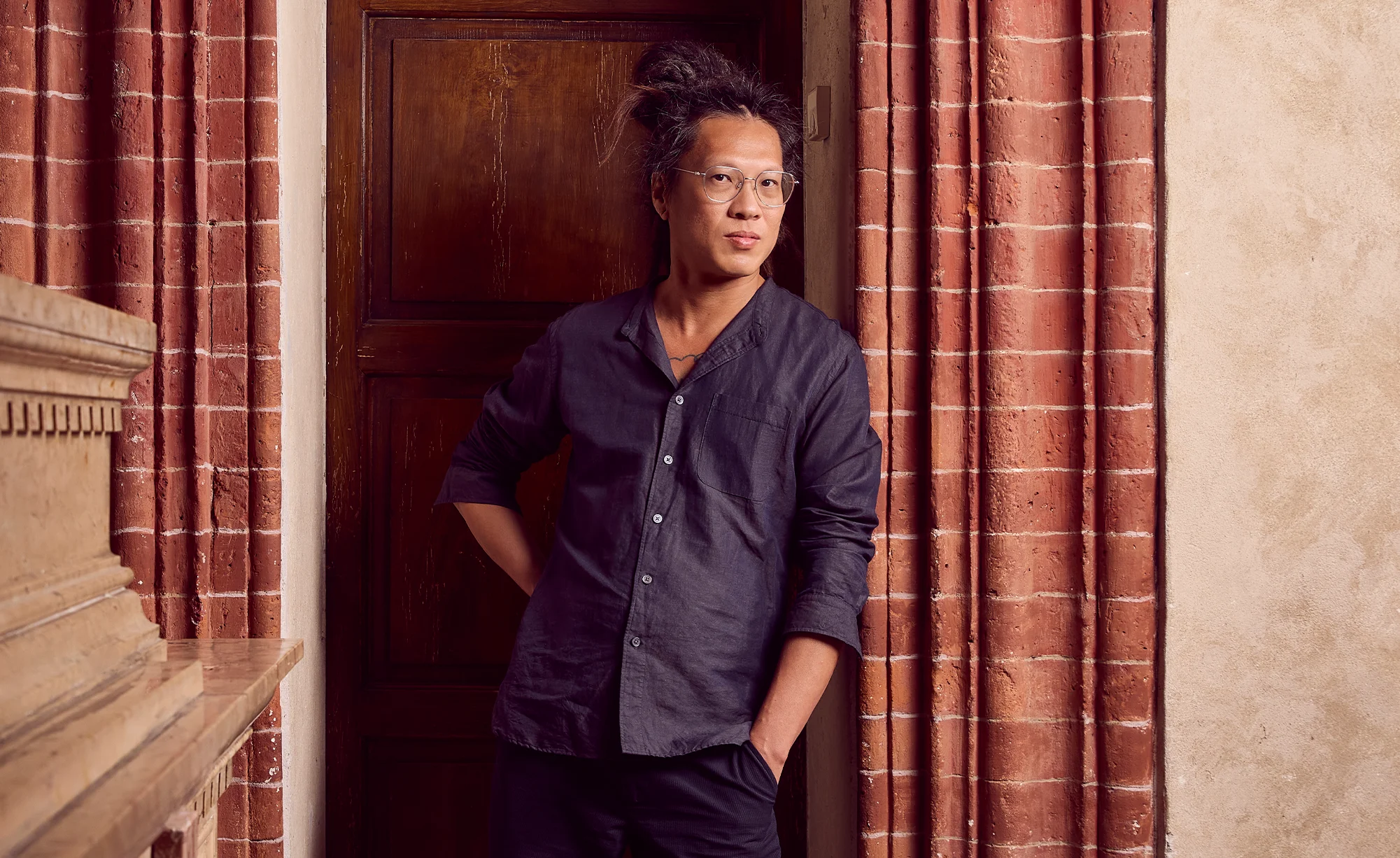
The founders of Yume Architects discuss design in Singapore, understanding the values behind a client’s brief, and why they encourage young designers to be curious beyond architecture and design.


Up next in our Singapore Design in Focus series we speak with Asami Takahashi and Dr. Jason Lim, Founders of Yume Architects, a Singapore-based design-focused studio whose portfolio includes residential projects, interior design, art installations, and urban planning. The studio’s name, Yume (夢), means dream.
Before her architectural training, Takahashi worked as a software engineer, and she is also a classically trained violinist. Lim completed his doctoral dissertation at the Gramazio Kohler Research Unit, Department of Architecture, ETH Zurich, and has previously taught at the Singapore University of Technology and Design, National University of Singapore, Stevens Institute of Technology, and Parsons School of Design.
In their joint interview, the pair discuss what makes design in Singapore distinct, how the role of design has evolved, and how they use technology in their practice.
They also discuss their approach to working with clients, from understanding the values behind a brief to recognizing what a client may be willing to reconsider. They prefer creative freedom within some constraints and explain how talking with clients can reveal what is left unsaid.
They also share their advice for young designers: “Be curious about many things beyond architecture and design. Read widely, make things, travel and pursue interests that may seem unrelated to your work.”


Since its founding as a port for entrepôt trade, Singapore has been conditioned to look outwards and engage with ideas and people from across the world. This has contributed to a design culture that is open and willing to absorb influences from different origins.
The result is a distinctive diversity that is amplified by land scarcity and density. An ornate Indian temple, 3-storey Chinese shophouses and high-rise modern apartment buildings can sit adjacent to one another in the same neighbourhood. The juxtaposition of differences becomes commonplace and accepted.
In fact, diversity is the theme of the 2025 Singapore Pavilion at the Venice Biennale, for which we designed the exhibit, curated and organised by the Singapore University of Technology and Design (SUTD).
Singapore is also a city in constant redevelopment where change is not considered anathema. New ideas can supersede the old, allowing a form of creative destruction to take place. So Singaporean design also has this chameleonic quality. On one hand, there is room for experimentation without being overly bound to historical convention or established design languages; on the other hand, it raises a question about authenticity and what is uniquely Singaporean.
Design responds to societal needs. Earlier in Singapore’s development, these needs were more basic in nature—housing, infrastructure, sanitation—and design leaned in a more functionalist direction.
There is a premium for novelty and originality in design beyond problem-solving.
Today, having successfully modernised, the challenges are less prosaic. One of them is differentiation: how does Singapore distinguish itself from other global cities, and how do its goods and services move up the value chain? Design becomes a signifier of identity and value. There is a premium for novelty and originality in design beyond problem-solving.
Another, perhaps more difficult, challenge for design lies in expressing the needs of a more pluralistic society, which are harder to quantify and align. For example, questions of equality, environmental stewardship, heritage and identity have become increasingly important but can come into tension with a national agenda of development, or with one another. We think design has a role to help negotiate between these competing interests and values.
Yes and no. Nowadays, clients are more exposed to design through social media, movies and publications, which is beneficial in terms of expanding their conception of what is possible. They can point us towards reference projects to communicate their stylistic preferences or identify features they wish us to incorporate. Where there is a precedent, clients are generally willing to support the proposal and invest in it.
For us, communication is important to find where the threshold lies between what a client is familiar with, and what they are willing to reconsider.
However, truly bold design beyond, for example, choosing unconventional materials, requires clients to imagine and commit to new forms of behaviour. This is much more difficult. In residential architecture, for instance, domestic lifestyles have become increasingly homogenised, creating standard expectations of what a house should be. In offices and civic architecture, established modes of operations can inhibit innovation.
For us, communication is important to find where the threshold lies between what a client is familiar with, and what they are willing to reconsider. But ultimately, we recognise that the client will live with the built result, and do not look to impose an abstract concept of innovation on them.
When I (Jason) completed my doctorate at ETH Zurich in robotic fabrication, much of the research was well ahead of what was taking place in practice and construction, so there was limited opportunity to apply it directly afterwards. Academia became an outlet for me to continue exploring my interests in design computation.
I taught courses in these subjects at the Singapore University of Technology and Design (SUTD) and the National University of Singapore (NUS). By educating a new generation of designers who would be more receptive to these methods, I felt that I could help shift the culture around technology in design.
By educating a new generation of designers who would be more receptive to these methods, I felt that I could help shift the culture around technology in design.
At Yume Architects, we do believe that algorithms can be an expressive medium for design intent and try to apply design computation where it can meaningfully contribute to a project. For example, we developed façade designs for several or our houses, such as in the Crescent Wall House and House of Light and Shadow, whose patterns and intricacy emerged directly from the possibilities of computation and digital fabrication.
These façades are not only functional in terms of screening harsh daylight, but also give the houses a distinct aesthetic quality.
The intersection of design and technology is most apparent in our exhibitions, including the Singapore Pavilion at the Venice Biennale in 2018 and 2025, and in art installations such as Body, Heart & Soul. Such projects call for novelty, and we are therefore able to invest more time experimenting with technology—for example, to produce more interactive, synaesthetic and delightful experiences.


All images provided by Yume Architects

We prefer to be given creative freedom but within some constraints. The best briefs do not simply list functional requirements but communicate the values of the client. Sometimes, by talking to them, we discover what is unsaid.
For example, in Linked Terraces, we noticed an undercurrent of melancholy when our client was discussing the project. She was emotionally attached to the single-storey house, which they planned to demolish and rebuild, because it embodied happy memories of her daughters’ early childhood. We realised it was important to honour this past and retain the old house’s sense of intimacy in our proposed design. We decided to conserve part of the original structure and introduced a sectional void to link all levels of the new house visually and acoustically, allowing the family of five to remain connected.
We prefer to be given creative freedom but within some constraints. The best briefs do not simply list functional requirements but communicate the values of the client.
Conversely, briefs that are overly detailed can be counter-productive because they define too narrowly what the outcome should be. In such situations, we still try to interpret the brief in different ways, for example, making one proposal more aligned with the instructions and another that challenges the client’s assumptions. We use them to have a dialogue with the client and explore different directions that the project can take.
At Yume Architects, we have always been enthusiastic about using new technologies to extend our capabilities.
However, our position is that we must retain full design authorship. There is a temptation to offload much of our cognitive design work to AI, especially because it is so pliant, capable and fast. We think this would be a mistake. The labour of designing is what allows us to develop and sharpen our abilities and judgement. Our capacity to produce distinctive and unexpected outcomes is built through this accumulation of work. The human aspect of design is therefore not a limitation, but an asset.
In addition, our profession is obliged to exercise a duty of care. We are ultimately responsible for our design decisions, which becomes problematic if we do not verify the results produced by AI or understand the processes through which they arrive at them.
The labour of designing is what allows us to develop and sharpen our abilities and judgement.
That said, architecture is not purely about design, and we see enormous potential for AI to assist us in other aspects of practice. We are less interested in using AI to produce spectacular images, for example, and more interested in exploring how it can be used to build knowledge bases from our internal data, check compliance with regulations, support early-stage research, and accelerate documentation such as specification writing.
This frees up more time for us to spend on the craft of design—a part of our work that we take great joy and pride in, and are not yet ready to delegate to a machinic agent.
Today there is a deluge of information which can overwhelm a young designer and crowd out the space for imagination. We would advise you to find and develop your own voice. Invest effort in the design process and resist the temptation to take shortcuts. Learn from others but do not simply imitate. Struggle is necessary and valuable: it will help you build up a reservoir of ideas and experiences from which you can develop your own distinctiveness.
Design is ultimately a reflection of yourself. The richer your experiences and the deeper your thoughts, the more unique and interesting your design can become.
Take your time to grow as a person. Design is ultimately a reflection of yourself. The richer your experiences and the deeper your thoughts, the more unique and interesting your design can become. Be curious about many things beyond architecture and design. Read widely, make things, travel and pursue interests that may seem unrelated to your work. Don’t be afraid to take detours, as Steve Jobs said, the points would eventually connect and make sense to you.
We would like to highlight an ongoing project, the Vivekananda Cultural Centre, which is scheduled for completion in early 2028. We received this commission after winning a design competition organised by the Singapore Institute of Architects (SIA) in 2025. Our entry was titled Under this Shelter you will find Rest after a quote by Sri Ramakrishna that was addressed to Swami Vivekanada, after whom the cultural centre is named.
The quote describes people gathering under the shade of a tree, which we interpreted as a powerful expression of hospitality and inclusivity. This evocative image became an important starting point for our design. The Vivekananda Cultural Centre has become meaningful to us on a more personal level because it is our first civic architecture project, and through it we realised something about the kind of work we want to do.
We discovered that we particularly enjoy working on projects with cultural significance—those that allow us to have deeper conversations about identity, culture, society and history. The centre is located on a compound that also includes an existing Hindu temple, Singapore’s first boys’ home and a kindergarten.
Through our conversations with the charitable organisation that runs the compound, we have been able to engage in meaningful conversations about who we are, how we understand our shared identity, and what kind of community we want to create. Architecture became a way for us to contribute to public life.
The Jurong Town Hall is not as widely known internationally as People’s Park Complex or Golden Mile Complex, but like them, it is representative of a period of architecture experimentation and modernism in Singapore’s post-independence history.
We have been inspired by the late architect Kerry Hill, who resided and practised in Singapore. We admire the restrained and elegant design language that he developed over the course of his career, which always seemed deeply rooted to its place
Bukit Timah Nature reserve is a tract of primary rainforest that despite occupying some of the most valuable real estate in the centre of Singapore, remains largely and thankfully untouched. We find this contradiction and its connection to Singapore’s deeper history inspiring.


All images provided by Yume Architects
To learn more, visit www.yumearchitects.com
All images provided by Yume Architects.
Photographs:
Tomohisa Miyauchi