


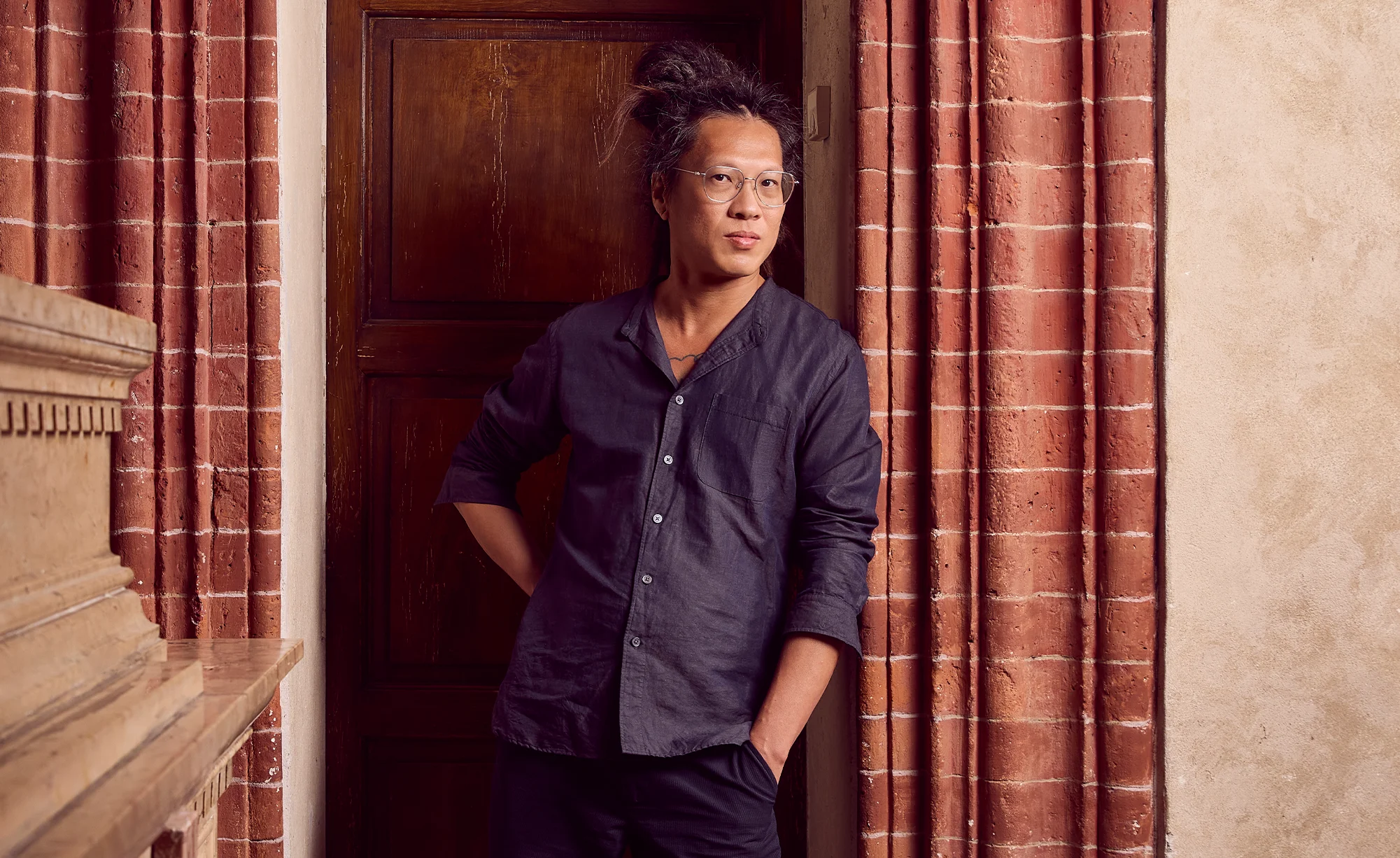


Up next in our Singapore Design in Focus series, we speak with Ng Sze Kiat, Founder of Bewilder, a mycological design studio that works exclusively with mushrooms, from designing with mycelium materials to farming rare varieties.
A self-taught cultivator, Ng says hours of trial and error led to happy accidents and, eventually, to R&D. After growing his first edible mushrooms, he broke up the spent substrate and placed it into vessels, where it grew back together, taking the form of its containers. It led him to consider using the farm’s spent substrate to grow art objects.

Bewilder’s works celebrate the unpredictability of a living material. Ng shapes it at the start, then steps back and lets the organism resolve the form. “Who is truly the designer? Is it me or is it the mushroom?” he asks.
Over the course of our interview, he talks about why each project should showcase the material’s inherent properties, the three principles growing mushrooms has taught him, and why Singapore’s cost of living pushes designers to think out of the box. He also explains why the projects that matter most to him are the ones not yet realized.
Bewilder describes itself as a mycological design studio. For someone encountering that term for the first time, what exactly does Bewilder do, and where does design fit into the work?
Mycology refers to the study of fungi, and Bewilder works exclusively with mushrooms- from designing with mycelium materials to farming rare mushrooms. Design is deeply rooted in our DNA, reverberating throughout our product lines as well as our farming processes.
On a deeper level, we also design the way we think, in order to be more like fungi.

What first made you see fungi not simply as something to cultivate, but as something you could design with?
As a self-taught cultivator, many hours were spent on trial and error, finding ways to grow mushrooms by first observing them in the wild. This has resulted in happy accidents which eventually led me down the R&D rabbit hole.
The first time I grew some edible mushrooms, I wanted to see how I could repurpose the spent substrate, so I broke them up and placed them into vessels. When they started to become one again, taking the form of the vessels, I got excited.
There is something very raw and ancient, yet refined and futuristic about the material, and I found it exciting and inspiring.
I remember thinking: what if I could use spent substrate from our farm to grow objects d’art? There is something very raw and ancient, yet refined and futuristic about the material, and I found it exciting and inspiring.
There was also a very prevalent sense of communication between these organisms and I, a negotiation in which I found to be very fulfilling when creating something: it felt more like a co-creation.

There is an inherent unpredictability in working with a living organism. How does that change the conventional relationship between designer, material, and finished object?
Our works are a celebration of this unpredictability. Although we shape the material at the start, we always take a step back and let the organism resolve the form.
Who is truly the designer? Is it me or is it the mushroom?
Thus the designer-object relationship is one that is fluid- one that requires respect, patience and letting go. Who is truly the designer? Is it me or is it the mushroom?

Bewilder has explored mycelium through lamps, furniture, installations, jewelry, and other objects. What makes an idea particularly suited to fungi, rather than simply making something conventional out of an unconventional material?
I always aim to showcase the inherent properties of the material in each project. If the material cannot answer a design problem, then it is probably best not to make it.
If the material cannot answer a design problem, then it is probably best not to make it.
For jewellery and arrangements, it is more of an opportunity to show off their inherently weird and wonderful beauty.

Your work brings together design, science, farming, craft, and art. What have you learned from working across disciplines that a more conventional design practice might not reveal?
Growing mushrooms has taught me some universal truths that I try to practice on the daily.
- Balance is key. Too much water and the mycelium drowns. Too little water and the mycelium is not able to survive.
- Timing is everything. Doing things too soon or too late are both grave mistakes.
- Everything is interconnected. Cause and effect infects, so every step is important. I always try to infuse these 3 principles into the undercurrent of our works.

Looking more broadly at Singapore design, where do you think designers here have the greatest opportunity to work differently?
Singapore is pretty expensive to live in, so designers here have to think out of the box to make things happen.

Could you share any Bewilder projects that feel particularly important to you, and tell us what made them significant?
The projects that feel important to me are the projects that are not yet realised. I am always working on new works and every new work inspires more new work, so the studio is always littered with works in progress.
Quick Hits
A lesser-known Singapore design or object that visitors should see:
Not so much an object, but we do have some pockets of nature that visitors should visit!
A material you’d love to experiment with alongside fungi:
Metal. Metal is sexy.
Something in Singapore that consistently inspires you:
The mushrooms!


