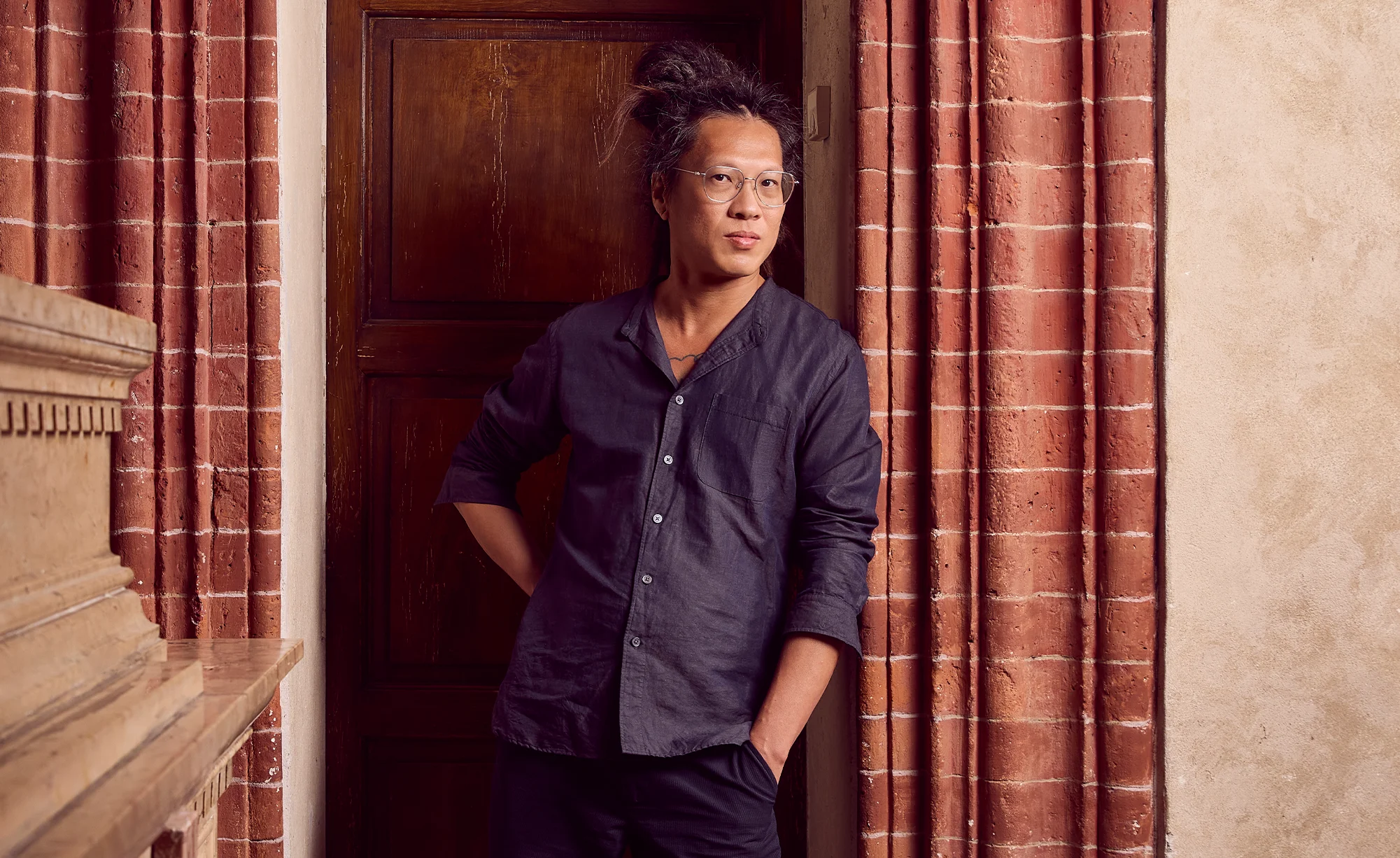
The content-first studio’s creative directors on the influences shaping Singaporean design, why form should follow content, and Cheng’s advice for young designers.


Up next in our Singapore Design in Focus series, we speak with Kelley Cheng, Creative Director and Founder, and Will Chong, Creative Director and Partner, of The Press Room, a content-first creative studio whose multidisciplinary team spans graphic, spatial, and digital design, editorial, and illustration.
Over the course of our interview, the pair discuss whether Singaporean design has an identity of its own, how the role of design has evolved alongside Singapore’s transformation, and how open clients have become to bold design choices.
They also talk about the studio’s principle that form follows content, the balance between a clear brief and creative freedom, and the role of AI in the industry and their own workflow.
The pair share three projects that stand out to them: ‘SGH at 200: Sanctuary and Stronghold,’ a two-book set marking Singapore General Hospital’s 200th anniversary; ‘Give Me Time (for a Book),’ a National Library Board initiative encouraging young people to engage more with their mother tongue; and ‘60/60: Singapore in Focus,’ an exhibition bringing together 60 artists to celebrate Singapore’s 60th year of independence.
For young designers entering the industry, Cheng offers this advice: “Don’t just ask if something looks good — ask why it should look that way.”


Kelley: Singapore – having been a British colony historically – is generally quite a westernised society. We grew up being fed on Hollywood movies and Western pop culture and that has deeply influenced the way we see things and consequently, the way we design. We don’t have a particularly long history of graphic design as a defined discipline, and hence as a relatively young design industry, we tend to take references from our visual diet.
So, to be honest, most good designs in Singapore are quite globalised and don’t really have a particularly Singapore flavour.
Will: We didn’t have a lot of time to forge a singular design identity of our own. In some ways, I think that’s still something we’re figuring out today.
Will: Design evolves with what the country needs. Earlier on, it was largely functional — signage, newspapers, magazines, labels and so on.
Today, its role has become much more experiential, shaping brands, campaigns, exhibitions and communities. Audiences have also become more sophisticated, so approaches to good design have become much more varied and layered.
Will: It depends on the industry, but yes, some clients are definitely more open to different approaches and more appreciative of good design.
We tell them that a safety net can eventually stop being safe, when the world has moved so far ahead that staying where you are means being left behind.
The challenge is often getting out of their comfort zone. We tell them that a safety net can eventually stop being safe, when the world has moved so far ahead that staying where you are means being left behind.
Kelley: We believe that design should not come from a pre-conceived notion of what it should be or, worse, a copy from Pinterest. We should always digest the brief and form a narrative that would inform the design.
We believe that design should not come from a pre-conceived notion of what it should be or, worse, a copy from Pinterest.
What the content conveys through words, the form should also convey visually — both should carry the same essence. One has to fully digest the content, then use that as the foundation for the design to grow from.
Will: Clarity is important so that we don’t misalign, but having room to experiment is equally important. Sometimes, it depends on the client too.


Will: To be honest, we’re still making sense of it. We use it more at a functional level, such as research, but as creatives, there’s still a sense of pride in wanting to come up with the ideas ourselves. So we don’t currently use it much for idea generation.
We use it more at a functional level, such as research, but as creatives, there’s still a sense of pride in wanting to come up with the ideas ourselves.
Kelley: In an era where aesthetics are plentiful and accessible, I think it becomes even more important to make designs that are layered with intentions and meanings, so that the viewers can appreciate it in a multi-dimensional way. Don’t just ask if something looks good — ask why it should look that way.
In an era where aesthetics are plentiful and accessible, I think it becomes even more important to make designs that are layered with intentions and meanings…
SGH at 200: Sanctuary and Stronghold:
A set of two books marking Singapore General Hospital’s 200th anniversary. Designed as a matched set, each cover offers a glimpse into its content — one tracing SGH’s historical arc, and the other featuring 26 personal stories shaped by its enduring presence. Together, they became a meaningful tribute to 200 years of service and the people behind it.
Give Me Time (for a Book):
This was an initiative by the National Library Board to encourage young people to engage more with their mother tongue by recommending Chinese books in a different way. Each postcard visualised a key narrative arc from a book, giving readers a glimpse of its story without giving too much away. We found it particularly meaningful because it was about finding a new way to make reading Chinese books feel relevant and engaging to a younger generation.
60/60: Singapore in Focus:
An exhibition bringing together 60 artists to celebrate Singapore’s 60th year of independence. What stood out to us was the range of artists, from young emerging practitioners to more established names, and the opportunity for them to share not just their work but also their creative processes. It felt like a celebration not only of Singapore, but of the people who continue to shape its creative landscape.
Kelley: There is actually this little shop in Chinatown that sells antique and new Peranakan tiles run by an old man who has a really interesting story. When he was a boy, he didn’t have money, so he would pick up Peranakan tiles from houses under construction or demolition.
He stashed them away for a really long time until one day he realised that there is actually an interest in these old tiles, so eventually he opened up this shop. So yes, old Peranakan tiles are a real Singapore treasure in terms of design, which not many know of. And even for me, I only knew it when we were working on a project documenting heritage businesses in Singapore.
Kelley: Lim Tze Peng. We had the privilege of working with him and his family on an exhibition and website as he approached 100, celebrating his milestone as Singapore’s oldest living pioneer artist.
Seeing his practice and passion up close gave us a much deeper appreciation of his work. If he were still around, I’d love to collaborate with him on something — I’m sure it would be interesting.
Will: Honestly, sometimes it’s just walking around. When I’m stuck on an idea, I’ll take a break, use the loo, look out the window and let my eyes wander. Taking myself out of the context of the project sometimes gives me the unexpected idea I need.


To learn more, visit www.thepressroom.com.sg
All images provided by The Press Room