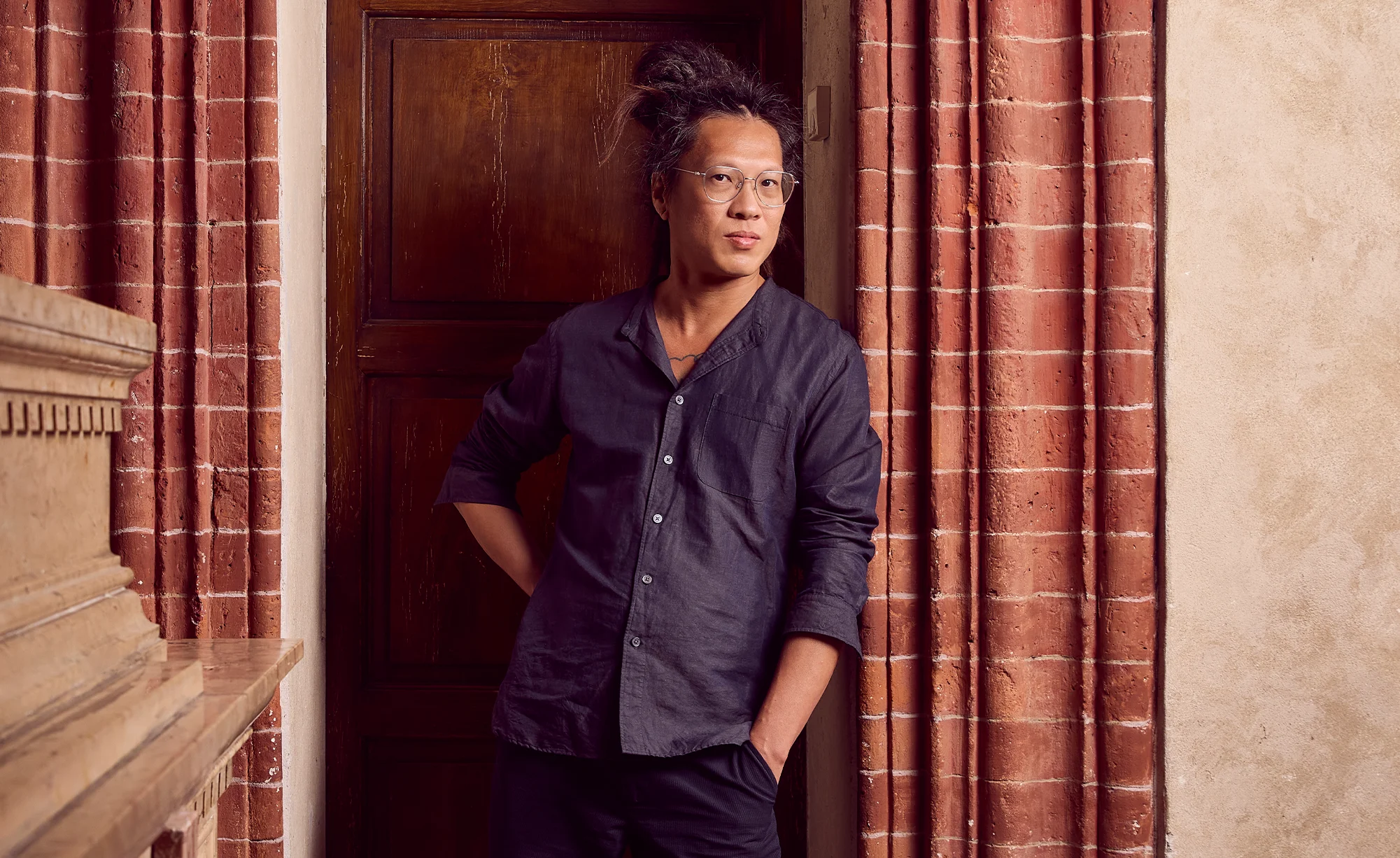
The Founder and Creative Director of Somewhere Else discusses Singapore’s design identity, clients’ appetite for unconventional work, and his concerns about AI’s impact on creative standards.


Up next in our Singapore Design in Focus series, we speak with Yong Ng, Founder and Creative Director at Somewhere Else, a boutique brand consultancy in Singapore. In our interview, Yong reflects on how design in Singapore has moved from a merely commercial function into more aspirational and cultural roles, and how the definition of a designer has expanded, giving practitioners more room to find their own niches.
For Yong, Singaporean work is not easily distinguished from international contemporary design. He suggests this is likely because client work typically needs to be exportable and the country’s culture is still very young, adding that if he were to identify a particular spirit in the work, pragmatism comes to mind.
Yong also discusses encouraging clients to embrace more unconventional ideas, pointing to the trust they place in the studio and work grounded in strategy. He explains that Somewhere Else’s clients are typically challenger brands, and its strategic approach is built on a challenger’s mindset – looking to carve out advantages in ways that incumbents cannot.
He additionally shares his concerns about AI-generated work and the broad acceptance of “standards lower than mediocre” – noting that while AI can be useful for menial tasks, it is not a tool for original thought.


Tough one. From what I’ve been seeing, works these days draw inspiration from everywhere. The most dominant trends tend to be of Western influence; Korean and Chinese contemporary design are rising in influence as well. Certain cultures have more distinct sensibilities and, because of their writing systems, unique typography.
Singapore work is not that much different from international contemporary design and can be difficult to distinguish, likely because our client work typically needs to be exportable and our own culture is still very young. If we’re trying to identify a particular spirit to the work, pragmatism comes to mind.
It’s great that design has moved from being a merely commercial function into more aspirational and cultural roles, shaping how we see and express ourselves beyond simply selling goods. The definition of what a designer is has also expanded, giving practitioners much more room to find their own niches. There’s a lot more recognition for the profession as well, particularly with DesignSingapore, National Design Centre and President’s Design Award.
Yes and no. Before Pinterest, there were intelligent workarounds, but certain clients could be significantly more adventurous. Whereas now, the general standard is fairly high but the finished work tends to sit in familiar territory. We rarely see truly outrageously bold work anymore, except at the fringes. So I’d describe the state as the middle’s appetite having grown very large: everything looks good, but much of it is far from innovative or inventive.
The general standard is fairly high but the finished work tends to sit in familiar territory. We rarely see truly outrageously bold work anymore, except at the fringes.
Frankly, much of our work is a dialled-back version of a bolder vision (granted, we’re greedy about how far we can push the work). Even if the client is ready for something strong, they often fear that their market is not, which is in no way unfounded. The market has come a long way in its sophistication, but that momentum has stalled and it will take time for standards to meaningfully shift again.
As for convincing clients, ours tend to trust us a lot, so we have a fair amount of leeway. Despite the work sometimes feeling compromised in our purist minds, they’re still good steps forward. As a brand consultancy first and foremost, our work is always grounded in foundational, strategic truths, be it the client’s ambition, customer sentiment or shifts in the market. We communicate in a common language that isn’t centred around aesthetics, so the trust and quality of the work come out of that relationship.
Our clients are typically challenger brands squeezed into difficult positions, and the key way for them to break out of whichever traps they’re in is to be unconventional in their branding. It’s therefore the foundation of our strategic approach to have a challenger’s mindset: looking to carve out advantages in ways that incumbents cannot. We challenge our clients to move away from established category practices and to visibly carry the difference they seek to make in a customer’s life.
Our clients are typically challenger brands squeezed into difficult positions, and the key way for them to break out of whichever traps they’re in is to be unconventional in their branding.
Hahah, tighter briefs are better because the goals are clearly established. “Free play” briefs usually aren’t actually open, and they tend to become black holes. What’s critical is establishing clear parameters around our client’s appetite and capacity for change; then it’s up to us to make the best of the situation.


It can be useful for certain menial tasks and cursory scans, but obviously not as a tool for original thought. It’s built on existing material and patterns, so relying on it too much only gets one so far.
Judging from how widely adopted it is, the amount of slop that’s come out, and how OK people are with the quality of its output, that is the most concerning aspect of the AI revolution.
There’s more promise on the agent-side of things but we’ve not figured out which of our work can be meaningfully automated, the time required to get that going is still substantial vs. time saved.
Judging from how widely adopted it is, the amount of slop that’s come out, and how OK people are with the quality of its output, that is the most concerning aspect of the AI revolution.
It signals to us that, at a very broad scale, people are accepting of standards lower than mediocre. And because it’s so fast and cheap, the deluge is overwhelming even at this early stage of adoption.
There is some pushback, but the momentum of adoption and wilful usage is too great at this time. So while on one hand we’re trying to push the work, and how far we can go is dependent on the market’s tolerance, we’re concerned that it’s going to become even harder to fight this mediocrity.
We finished a brand refresh/e-commerce project for RJ Paper, a vendor turned friend just before Covid and she credits that as a big help in keeping them accessible through the pandemic; and so that’s heartening.
After the pandemic, we started working very closely with Seek Sophie, helping them shape their voice and give form to their vision; which has helped move the needle for their business.
Recently, we helped a new generation of a family business (Hock Siong) clarify their value proposition without changing who they were; and we think we handled their legacy well.
These days, our work in FMCG/Retail has been particularly meaningful as their reach is wide and they touch many lives. It all started when Oatbedient gave us a chance and more recently, our work for Mr. Bucket has been a wonderful partnership.
We’re just very thankful that we’ve worked with so many businesses that care deeply about the people and community they serve.
SHRUBS would be a great store to visit to see what the Singapore voice is like on the fringes.
We have many local heroes that we look up to but of them we’ve been particularly inspired by their differentiated ways of seeing: StudioJuJu, H55, Hans Tan, Robert Zhao, Crystal Lee (Project Coal), Classified Footwear (Shoe customisation), Keenway (Pizzas)
I’m mostly a desk-bound thinker, but I also spend an inordinate amount of time in the nature parks to drown out the noise.


To learn more, visit somewhere-else.co
All images provided by Somewhere Else