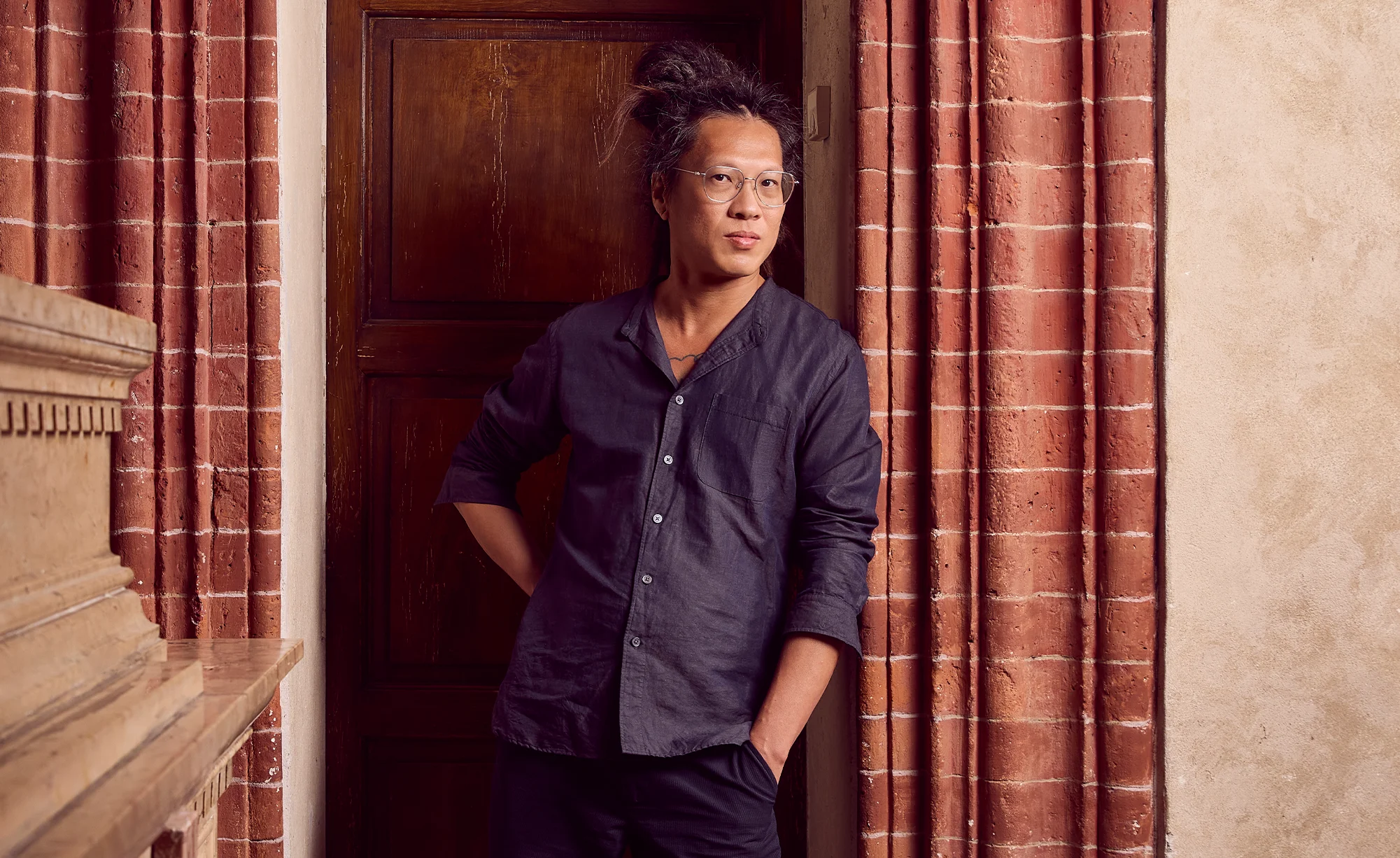
The Founder and Creative Director of Practice Theory reflects on why Singapore’s design draws on many influences rather than a single style, the role of trust in pushing clients toward bolder work, and advice that shapes the way he works.


Up next in our Singapore Design in Focus series, we speak with Randy Yeo, Founder and Creative Director of Practice Theory, a branding and creative agency. Yeo reflects on Singapore’s design industry, from advertising’s influence in the 1990s to design thinking in the 2010s and a return to smaller, community-based practices today.
For Yeo, Singapore’s evolving national identity helps explain why its design landscape has no singular design language. He points to the different influences and perspectives found across local studios, reflecting the country’s diverse culture.
Yeo also discusses the importance of trust in encouraging clients to take creative risks and Practice Theory’s three principles: bold ideas, elegant thinking, and rigorous craft. On AI, he explains how he uses it to help run his studio while emphasizing the value of human judgment, taste, and creativity.
When asked what he wishes someone had told him when he was starting out as a designer in Singapore, Yeo instead shares advice he received that has shaped his approach to work, from chasing dreams with youthful naivety to continually reconciling and re-evaluating one’s relationship with craft and money. And, as a little something extra, there is some guidance from Biggie.


The interesting thing is that Singapore, unlike more established design cities, is still a very young country. Our national identity is still evolving, and many of us are still asking what it means to be Singaporean. So, it is no surprise that we haven’t developed a singular design language in the way Japanese or Scandinavian design has. Our early and constant exposure to international work instead resulted in a mishmash of styles and ways of thinking.
The interesting thing is that Singapore, unlike more established design cities, is still a very young country.
You can see this in the output of our local studios. Each has its own point of view, and you can trace the different branches of influence—it’s quite reflective of our diverse culture.
Interesting question…There’s actually a popular argument here that Singapore is a city by design. As a city-state with no actual resources, everything—from public housing policy and transport systems to the way we plant trees—has to be deliberately planned and built from the ground up.
Post-war Singapore was also a very exciting time for the country, especially for architecture. Buildings like Golden Mile Complex (my personal favourite) were beacons of hope for a brighter future, expressing new ways of living through metabolic structures. There’s a famous quote from Fumihiko Maki, of the Japanese Metabolist movement: “We theorised, and you people are getting it built.” To this day, the building, and the hopefulness it represents, still makes me proud.
It’s quite nice that design in Singapore has kinda gone full circle back to a smaller, more community-based mode of practice.
Then we look at the 90s, when design was all about selling. This was largely shaped by the boom of advertising agencies (there were hardly any design studios). In the 2000s, postmodern influences came to the fore, with a stronger emphasis on finding an individual voice. By the 2010s, the focus had shifted towards design thinking and design as a method of problem-solving. This brought along its own set of questions of criticisms, of course.
Now, because of heightened exposure and tougher economic climate, the definition of design (and a design studio) is constantly reworked. Designers are pushing their practices beyond conventional client work and into interesting new realms. Smaller and more agile outfits, like what gideon–jamie is doing with Temporary Press and their bookshop, what Darius Ou is doing with 3-D printing books, and other informal collectives come to mind. It’s quite nice that design in Singapore has kinda gone full circle back to a smaller, more community-based mode of practice.
Haha, I’m not sure. I’d say only a handful of them have always been bold; the rest probably will never be. That’s always been the case, and I don’t think it is specific to Singapore. What’s changed is that more clients have seen enough good work to recognise it when it is in front of them.
Over the last few years, in particular, I tend to find that clients have become more conservative. Partly due to budget cuts and whatnot. Nonetheless, we still try to push them towards bolder choices and encourage them to challenge themselves when we can. Ultimately, it comes down to trust. I’m glad we have clients who trust our approach and vision enough to allow us to push the boundaries together.
To us, bold ideas are what create change. We want to move brands from where they are to where they need to be, which often means being willing to push things somewhere new.
Elegant thinking then is really about clarity. The problems brands face can be complex, but our job is to understand them well enough to express them simply and elegantly.
And rigorous craft comes down to care. That’s care for the details, the design, and the integrity of the work itself. A lot of effort goes into making something feel clear, simple and effortless.
That’s what sets us apart.


Sounds cliché, but designers always get lost on an empty page. The best projects begin with clients who already understand our work and come to us with clear parameters—whether around taste and/or budget—while giving us the freedom to play within those lines. This also comes with trust, allowing us to stretch those boundaries, or break out of the sandbox entirely.
Something we also enjoy is having meaningful discussions with clients. Sometimes, they see things we can’t see. That two-way exchange makes our work more meaningful.
I use AI constantly, but almost never for making. It’s good at the parts of running a studio that used to eat my week—stuff like structuring an argument, pressure-testing a position, drafting the fourth version of a document. It gets from 0–7 really quick, but we also know the magic is getting it to 8, 9, or 10.
I use AI constantly, but almost never for making. It’s good at the parts of running a studio that used to eat my week.
Where I’m skeptical is generated visual work. It’s built from what already exists, so its output tends towards the expected and average. The value of a designer lies in our judgement, creating something that doesn’t yet exist. That’s where the real work and craft comes in.
As I said earlier about the studio’s approach, craft, judgement and taste are the things that sets us apart from the machine. AI raises the floor, but creativity raises the ceiling.
I’ll share a few things people have told me that have shaped the way I work:
– Chase your dreams with some youthful naivety before the realities of life and mortgage hit.
– Reconcile (and constantly re-evaluate) your relationship with your craft and money. It will almost always inform how you see your creative work.
– Stay hungry even when you’re being fed well.
– The Ten Crack Commandments by Biggie is the best boilerplate for running a business.
For projects he considers particularly meaningful, Yeo shared a selection of work from Practice Theory spanning branding, book design, custom typography, and exhibitions. These include:
Architecture from the post-war era—my two favourites are Golden Mile Tower and the Singapore Conference Hall (formerly the Singapore Conference Hall and Trade Union House).
Let me be greedy and name a few in the hope of speaking it into existence:
Musician Akeem Jahat, artist Genevieve Chua, sculptor Han Sai Por, textile studio TANCHEN, clothing brand GRAYE.
I also want to work with more chefs to see how food and design can come together.
My own head.


To learn more, visit practicetheory.com.sg
All images provided by Practice Theory