From documenting Tokyo’s electronic music scene to executive producing an award-winning video for Megan Thee Stallion, Mike Sunda’s path through Japan’s creative industry has been anything but conventional.
As Co-Founder of PUSH Japan, he’s helped shape the agency into a globally recognized independent studio, partnering with brands like Nike, Amazon, and Manchester City FC, while also producing culturally resonant work for artists including Rosalía and Arlo Parks.
In this conversation, Mike talks about Tokyo’s evolving creative landscape, the challenges of scaling an independent agency, what makes Tokyo such an attractive hub for creatives, the importance of cultural authenticity in brand strategy and storytelling, and his recent ADFEST talk, When Cultures Collide: Reinventing ‘Cool Japan’ Through Diverse Perspectives.

You were a music journalist before moving into brand strategy. What led to this transition? How did it shape your approach to creativity and business?
This is probably the least controversial thing I’ll ever say, but I think journalism nurtures the perfect skill set for a career in strategy: Research via a breadth of methodologies, critical thinking, and – most importantly – storytelling and clarity of communication.
I found all of those pivotal to success as a strategist, and they’re also useful for creative production and running a business. The difference is that for the latter two, you also need to be willing to get hands-on and embrace the chaos of elements that are ultimately out of your control, which strategists typically have the luxury of avoiding.
What were the biggest challenges and breakthroughs in scaling an independent creative agency in Japan?
We launched the Tokyo office in January 2020 so the biggest challenge was definitely surviving during the downturn in work during that first pandemic year when in-person content production was impossible and most projects were cancelled.

After that, we’ve been fortunate enough to grow consistently year-on-year, but scaling has certainly come with its own challenges – managing cashflow, hiring the right talent, and learning to say “no” to projects.
“I often joke that ‘creative director’ is the new ‘English teacher’ in Tokyo.”
The biggest breakthrough recently has been de-prioritising retainers. We’ve switched to a model where we almost exclusively do project work – which sounds scary given that we have 10 people on salary and significant overheads – but it’s actually freed us up in a way that has only increased revenue and profitability, even though it might sound counterintuitive or go against conventional wisdom.
What makes Tokyo such an attractive hub for creatives, and how has it evolved in recent years?
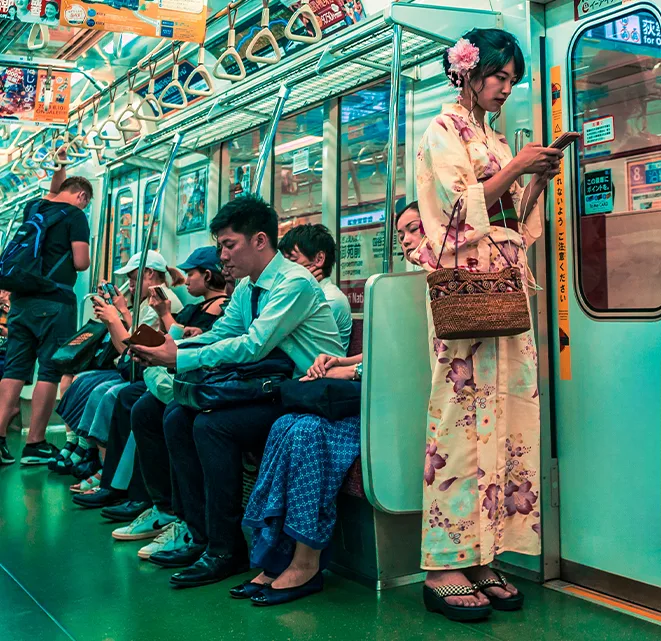
I often joke that “creative director” is the new “English teacher” in Tokyo – there are so many, and it makes sense because the city is so full of creative inspiration, and has such a rich cultural history to draw from.
The ubiquity of English-language signage, globalized platform infrastructure like Airbnb and Uber, the weakened Yen… all of these make it easier than ever to move here. On the flipside, you still have to be a top-tier creative in your discipline to stand out, and you need a deep understanding of the language and/or the business culture to guarantee longevity in a creative career.
What inspired you to create the Tokyo 20XX project, and what was the most valuable insight you discovered through it?
We looked a lot at street sports and the dichotomy between the rules and regulations that prevent a culture like skateboarding from freely flourishing in Tokyo, versus the incredible potential for success. Now you look at the likes of gold-medal winner Yuto Horigome and they’re voicing the same concern – at what point does the city need to rethink its identity before stifling a generation of other potential stars?
“The philosophy behind the “Tokyo 20XX” project was to dive deep into the city from both a cultural and infrastructural perspective.”
There was more to it than that, but the philosophy behind the “Tokyo 20XX” project was to dive deep into the city from both a cultural and infrastructural perspective, identify the hurdles preventing certain cultural scenes from thriving, and work with brands and institutions to create solutions.
When working with major brands like Nike and Apple or artists like Rosalia and Arlo Parks, how do you ensure cultural authenticity while also making work that resonates on a global scale?
That’s precisely the challenge, but it’s not one or the other – cultural authenticity is a driving factor in producing work that resonates on a global scale. So many people around the world love Japanese culture, have visited Japan, and want to know more – in that sense, the more authenticity, nuance, and context that you can weave into a production, the better it will be.
The video for Rosalia’s “Tuya” is a good example where you have beautiful visuals of historic onsen baths and Shibuya Crossing that will appeal to a mass audience, nods to aspects of Japanese culture like love hotels and pachinko that will satisfy a more “Japan-literate” viewer, and then incredibly granular details like Savoy pizza and Ichiran ramen order-sheets which will amuse Tokyo residents and regular visitors.
How is your agency embracing AI and how do you see technology reshaping the creative industry in the coming years?
We use AI for storyboarding because we find that Japanese clients, in particular, often want quite literal mock visuals during pre-production even for formats like a short-form documentary, whereas we’d ideally prefer to avoid storyboarding and stick to a mood board.
As a compromise, having one of our creatives directly generate images on something like Midjourney feels like a good middle-ground that also doesn’t drain time and resources to the extent that the traditional storyboarding process would. Beyond that, AI solutions aren’t a huge part of our workflow – we deploy them in very specific circumstances as a deliberate creative or execution tool.
Our recent post-production work for an Adidas Japan skateboarding video – which combines “conventional” low-fi skate visuality with 3D spatial scans and virtual camerawork – is a good example of how contemporary tech can be used even in cultural spheres that might seem completely oppositional, as long as it’s done with purpose and with strong creative sensibilities.
What advice would you give to young creatives looking to break into the creative industry in Japan?
Assuming that this question is aimed at an overseas audience, rather than creatives born-and-raised in Japan:
- Respect your elders – experience doesn’t count for everything, but it does count for some things.
- Learn to read, write, and speak Japanese. It will make your life in Japan more rich, rewarding, and open up new pathways in your career.
- Don’t chase money in your twenties – Tokyo is probably one of the only major cities in the world where you can have as much fun, or perhaps even more fun, on an entry-level salary.
- Say yes to every passion project.
- Explore East Tokyo once in a while – when you hit thirty, all your friends will live in Setagaya-ku or Meguro-ku and Yanaka will seem like a distant dream.
- Acknowledge that Tokyo is not representative of the rest of Japan and that your lifestyle is not indicative of anything beyond a tiny bubble of internationalized creatives.
- Find the best local spots in your neighborhood and don’t tell a single other soul about them.
- Pay your taxes on time – you will regret not doing so years later.
- When you pray at a shrine, start with your name and address – the gods will not be able to find you otherwise.
- Wear sunscreen.
“When you pray at a shrine, start with your name and address – the gods will not be able to find you otherwise.”
As the executive producer of Megan Thee Stallion’s Mamushi, what was the vision behind the project, and how did it come together?
Honestly, the director’s treatment by Onda was already in a great place. It wasn’t like other videos where we’ve had to educate overseas creatives about problematic stereotypes or Orientalist fantasies like nyotaimori – his idea, rooted in Japanese folklore, was incredibly exciting to us at first glance, with no red flags attached.
We had a quick discussion around the potential militaristic implications of styling the “blue-face troops” too closely to Akira Kurosawa’s “Dreams” in a post-reinterpreted-Article 9 Japan, but aside from that, Onda’s vision already looked incredible as-is, and it was just our job to realize it.
The cameo from Show Kasamatsu was a cool detail that we made happen, and obviously, the production design and locations were incredible, facilitated by really talented specialists that we brought on board.
The vast majority of credit should go to the hard work of Saka and Sarah, the producers – who had less than ten days for pre-production – and the broader production team, who basically didn’t sleep for 48 hours on set.
You recently spoke at ADFEST on When Cultures Collide: Reinventing ‘Cool Japan’ Through Diverse Perspectives. What prompted the rethink, how was it approached, and how is it going?
I pitched the topic a few months ago because it felt like a recurring theme within our work – the way that we’d been getting projects from such a diverse range of international artists, and also internally crewing up quite deliberately in a diverse way.
But the actual talk I gave only really crystallised the day before, when my friend sent me a photo of Frank Ocean in Tokyo that had been doing the rounds online, and it made me question why so many celebrities – from Frank to Harry Styles to Ye and beyond – spend so much time in Japan, and feel so comfortable embedded within the culture.
There are obviously societal and (infra)-structural reasons – the anonymity and relative absence of paparazzi, the sweet spot between the established creative industry alongside the “purchasing power” against the weakened Yen – but the more interesting topic is, in my mind, how Japanese culture is so far beyond the “Cool Japan” narrative, and its pillars and tropes of anime, idol music, craftsmanship and cosplay and so on.
“The actual talk I gave only really crystallised the day before, when my friend sent me a photo of Frank Ocean in Tokyo that had been doing the rounds online, and it made me question why so many celebrities – from Frank to Harry Styles to Ye and beyond – spend so much time in Japan, and feel so comfortable embedded within the culture.”
Instead, I make the argument that Japanese culture has spread globally through cultural spheres, and cultural figures, that have essentially emerged from certain “fringes” that represent a non-hegemonic expression of Japaneseness. That’s what’s captivating global audiences right now.
Whether it’s NIGO from a street culture background, Yuto Horigome winning gold medals in skateboarding – a sport that is still antithetical to the government’s ideal of “the city of Tokyo” – or the podcasting success of figures like Kemio and Naomi Watanabe, these are the people catalysing “Cool Japan” for a contemporary global audience, especially when they intersect with global tastemakers like Megan Thee Stallion, Pharrell and so on.
View this post on Instagram
I’m interested in how their organic expression of “Cool Japan” – which is often actually critical of Japan itself – is proving to be more engaging and relevant to global audiences than any state-driven cultural narrative, and what that means in the context of cultural consumption and cultural production.
Quick Hits:
Most useful app or tool you’ve started using recently:
No apps, just vibes.
Favorite show you’ve been watching lately:
I’ve been rewatching The Wire, which for me is still leagues above any TV show that has come since.
Something you want to learn or wish you were better at:
I hate that I’m not better at chess. I’d like to think that I’m reasonably intelligent, and on paper, I’m a strategist, so it humbles me how utterly mediocre I am at chess.
I play blitz games almost every day on the Chess.com app, I watch chess videos on YouTube, and yet, not only does my ELO (rating) not improve, it actually gets worse each month.