
As part of our Indian Design in Focus series, we speak with the Design Principles of Sfuurrna Akrriitt about what shapes Indian design today, how traditional knowledge systems inform their practice, and the deeper philosophical lens that guides their approach.
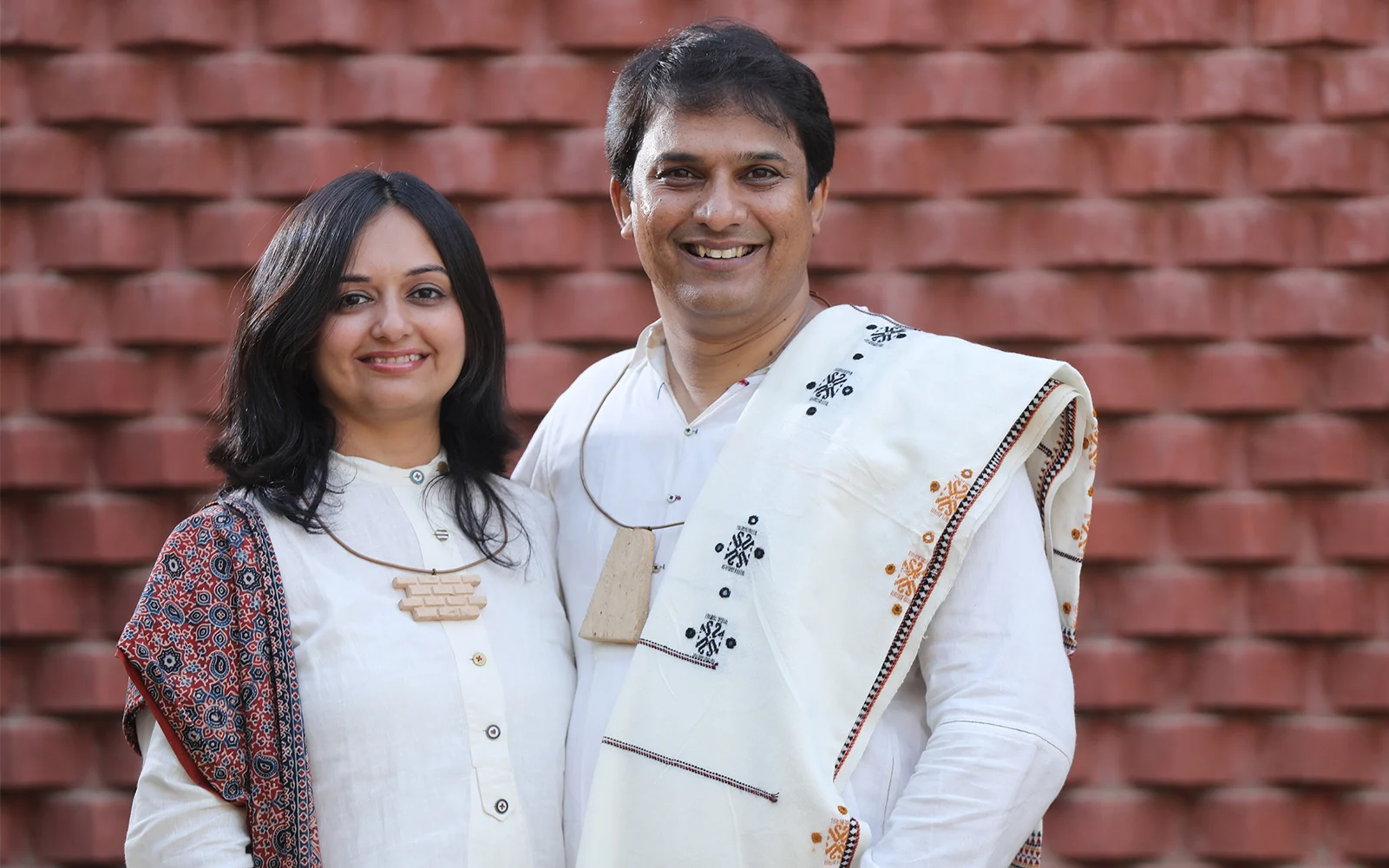

Architects Kalapi A Buch and Maitri KB Buch, Design Principals at Sfuurrna Akrriitt are guided by the belief that design begins with a spiritual understanding. When asked what makes Indian design unique, they told us, “In essence, what distinguishes Indian design is that it is not a style but a spiritual continuum — a living dialogue between the visible and the invisible, the maker and the divine, forever guided by the Sanātana Tattva — the truth that never fades.”
While their practice spans architecture, interiors, landscape, urban design, and product design, their thinking is rooted in a deeper philosophy: that Indian design is not a visual style, but shaped by consciousness, harmony, and the interdependence of form and spirit.
In this conversation, they reflect on how traditional Indian knowledge systems inform their work, from the idea of the Bīja — the seed of intent guiding each project — to Samagrata, the sense of wholeness that binds architecture, landscape, and interiors into a single flow.
They also discuss the renewed curiosity around India’s roots, the growing confidence among clients to embrace bold ideas, and why qualities like Tapas, Niṣṭhā, and Anuṣṭhāna remain central to the creative process.


In our view, what sets Indian design apart from other global styles is its profound anchoring in the ethos of Sanātana Sanskriti — the eternal way of being that perceives the universe as a living, conscious continuum. Here, creation is not a mechanical act but a sacred unfolding, where every element — sound, form, light, texture, and life — exists in interdependence, reflecting the timeless truth of “Vasudhaiva Kutumbakam” — the world is one family.
The very name Bhārata embodies this essence. Derived from “Bha” (light, knowledge) and “Rata” (immersed, devoted), Bhārata means “the land where people are devoted to the pursuit of light — of knowledge and truth.” Thus, Bhārata is not merely a geography but a sacred vision — a civilization rooted in Jñāna (wisdom), Dharma (righteousness), and Saṁskāra (refined conduct), where design emerges as a reflection of consciousness rather than a pursuit of form.
In essence, what distinguishes Indian design is that it is not a style but a spiritual continuum — a living dialogue between the visible and the invisible, the maker and the divine…
Within this continuum, design becomes an Ābhivyakti — an expression of the Ātman (spirit) manifesting through Rūpa (form). It seeks Samanvaya — harmony between Deha (body), Manas (mind), and Ātman (spirit); between human life and the larger rhythms of nature; between the material and the transcendental. Each act of creation aspires toward Samatā (equilibrium), guided by Śraddhā (faith), Anugraha (grace), and Ṛta (cosmic order).
Whether it reveals itself in the geometry of a temple, the cadence of a rāga, or the intricacy of a handwoven vastra, Indian design celebrates multiplicity while unveiling unity — Ekam Sat Viprā Bahudhā Vadanti (the truth is one, the wise call it by many names). It is fluid yet anchored, diverse yet cohesive, ever-evolving yet eternal.
In essence, what distinguishes Indian design is that it is not a style but a spiritual continuum — a living dialogue between the visible and the invisible, the maker and the divine, forever guided by the Sanātana Tattva — the truth that never fades.
Centuries of invasions and foreign rule fragmented India’s Vedic cultural continuum, leaving behind only traces of a once seamless flow of knowledge. In architecture and design, the profound wisdom encoded in our ancient texts was long dismissed as superstition — not because it lacked substance, but because few could truly perceive the depth and evolved understanding it carried.
In recent years, however, there has been a resurgence — a turning inward to rediscover the wisdom our ancestors entrusted to us. We are now approaching traditional Indian design afresh, not by replicating its outcomes, but by deciphering the processes and consciousness that shaped them.
Our exploration through the fusion of Indian Classical Music with Architecture and Design — which we call Muziteccture or Swarakritti — is one such endeavour. It seeks to translate rhythm, proportion, and harmony into spatial language, where architecture begins to breathe like a rāga, and design becomes a living resonance.
We are now approaching traditional Indian design afresh, not by replicating its outcomes, but by deciphering the processes and consciousness that shaped them.
Parallel to this, the Japanese design approach has deeply inspired us. Rooted in their own ethos, Japan has shown how tradition and modernity can coexist — fusing engineering, technology, and new materials with cultural subtlety to shape a design language that is globally relevant yet profoundly local. Their example reaffirms our belief that India’s design evolution too must emerge from authentic rootedness, refined through awareness, innovation, and purpose.
Working across diverse realms such as architecture, landscape, and interior design continually deepens our understanding of the principles that lie at the heart of our Sanskriti. Among them, the idea of the Bīja — the seed — forms the foundation of our creative process. The Bīja represents both origin and potential, the subtle essence from which every form of creation unfolds.
In our view, each project, space, or idea carries within it a Bīja — a seed of intent, an inner vibration of consciousness — that, when nurtured, naturally reveals its form, rhythm, and expression.
From that Bīja emerges the idea of Samagrata — the state of wholeness and integrative harmony. In our Sanskriti, there is no separation between the physical and the metaphysical, between structure and spirit. Everything — Prakṛti (nature), Puruṣa (consciousness), Kāla (time), and Deha (form) — belongs to one continuous flow.
In our view, each project, space, or idea carries within it a Bīja — a seed of intent, an inner vibration of consciousness — that, when nurtured, naturally reveals its form, rhythm, and expression.
This awareness of interconnectedness shapes the way we design — where architecture extends into the landscape, the landscape breathes into the interiors, and every element participates in a shared rhythm.
Thus, design for us is not about assembling parts but about revealing unity — nurturing Samanvaya, the alignment of form, function, and feeling. Each project becomes an exploration of its Bīja and a celebration of its Samagrata — allowing the tangible and intangible to meet in quiet, resonant harmony.
Yes, over the years we have witnessed a remarkable shift in the acceptance of bold design choices across Bharat. Of course, several factors have contributed to this transformation — the internet wave that has made everything visible and accessible, social media platforms that have broadened exposure and aspiration, and the economic rise of Bharat which has infused Bhāratīyas with greater confidence in self-expression. Collectively, these have opened minds and nurtured a more fearless design outlook.
We have found that clients become truly open to bold ideas not through persuasion, but through trust — when they sense in the designer certain enduring qualities.
But with us, it has always been so — not as a response to trend, but as a reflection of timeless principles rooted in our Sanskriti. We have found that clients become truly open to bold ideas not through persuasion, but through trust — when they sense in the designer certain enduring qualities.
The first is Tapas — the inner fire and steadfast perseverance that carries an idea through to its rightful form.
The second is Niṣṭhā — the sincerity of approach, where every decision arises from integrity and clarity.
Then comes Anuṣṭhāna — the sacred devotion to process, where design is allowed to evolve with awareness and grace.
And finally, Ātmābhivyakti — the revelation of one’s authentic nature, where each space is created as an expression of individuality rather than generality.
When these four — Tapas, Niṣṭhā, Anuṣṭhāna, and Ātmābhivyakti — become evident in a designer’s being and practice, clients naturally begin to trust. And that trust is what invites boldness — for they can sense that what is unfolding is not merely new, but true.


One of the most compelling shifts we see today is the growing awareness and the drive to rediscover our roots, sparking a quiet yet powerful design movement across Bharat. This resurgence is still taking shape, but we believe its most mature and blossomed expression will emerge over the next two to three decades — the seed has been planted, and its time of flowering will come.
Sustainability continues to be the most resonant and necessary theme, though it must evolve beyond a buzzword into a way of being — an intrinsic value rather than an external strategy, which this culture has always believed in.
As the fourth-largest economy, soon to become the third, Bharat now stands at a pivotal threshold. With this progress comes a desire to portray a new self-image — moving from the mindset of scarcity to one of responsible prosperity. This ambition is visible in numerous large-scale civic developments that aim to reflect Bharat’s renewed identity and confidence, often engaging some of the world’s best minds, much like the Middle East has done in recent decades.
Sustainability continues to be the most resonant and necessary theme, though it must evolve beyond a buzzword into a way of being — an intrinsic value rather than an external strategy, which this culture has always believed in. At the same time, Artificial Intelligence is reshaping every aspect of design thinking. We cannot yet imagine its complete form, but its contribution today — in ideation, visualization, and precision — is undeniably transformative.
Amidst this evolution, the neo-rich Indian society remains at a crossroads — torn between the Western pace of life and an inner yearning for authenticity and balance. This duality, we feel, is shaping a new design narrative — one that seeks rooted modernity and conscious living.
Barring a few, the design education scene in our country truly needs introspection — to reflect on where it is leading young designers and what kind of creative consciousness it is nurturing. While the intentions of most institutions may be progressive, the curriculum often remains uprooted from the very soil that holds one of the richest artistic and philosophical heritages in the world.
Our design schools must begin to respect and re-engage with the depth of our own Sanskriti — to understand that the roots of Indian creativity were never utilitarian, but deeply spiritual. Every art form — Nāṭya (dance and drama), Saṅgīta (music), Vāstu (architecture), Kāvya (literature), and Yoga — was never seen merely as expression, but as Sādhanā, a sacred discipline that aligned the individual with the cosmic order.
Our design schools must begin to respect and re-engage with the depth of our own Sanskriti — to understand that the roots of Indian creativity were never utilitarian, but deeply spiritual.
In Saṅgīta, for instance, lies the principle of Nāda Brahma — sound as the form of the divine. The universe itself is perceived as vibration, and music becomes a means to tune the human spirit to that universal resonance.
Similarly, Nāṭya was conceived as Nāṭya-Yoga, where movement, emotion, and rhythm become paths to Ātma-vikāsa — the blossoming of the inner self. Kāvya, our literature, was treated as Sahitya-Sādhanā, where words were not just written for expression, but for Ātma-sākṣātkāra — self-realisation through beauty, truth, and harmony.
These ideas are not ancient relics — they are timeless design philosophies, waiting to be reinterpreted. Yet today, our design education often prioritises technique over temperament, outcome over process, and market relevance over Saṁskāra — the cultivation of sensibility and purpose.
The challenge before us is not merely to modernise our design pedagogy, but to re-indigenise it — to draw from the eternal principles that once made Indian art forms holistic, humane, and universal.
The challenge before us is not merely to modernise our design pedagogy, but to re-indigenise it — to draw from the eternal principles that once made Indian art forms holistic, humane, and universal. When Sādhanā replaces mere skill, when Saṁskāra informs creativity, and when design is again seen as Yajña — an offering rather than an exhibition — we will begin nurturing designers who create with consciousness, grace, and responsibility.
Only then will education cease to produce professionals alone and begin to shape cultural custodians — designers who can bridge the timeless and the contemporary, the sacred and the functional, making Bharat’s creative voice once again luminous, rooted, and whole.
To us, Rajasthan — especially Jaisalmer, Jodhpur, Jaipur, and Udaipur — architecturally embodies an experience like no other. The textures of stone, the play of light, and the timeless craftsmanship make these cities living museums of Bhāratīya design sensibility.
But beyond built form, what truly reveals the soul of Indian design are the festivals celebrated across the country. Each transforms the landscape into a multisensory experience — the streets, homes, and institutions come alive with colour, music, food, attire, rituals, and collective joy. The entire community becomes both creator and participant in an immersive design narrative.
For instance, Navratri in Gujarat with its vibrant Garba, or Durga Puja in Kolkata with its grand Pandals; Ganesh Chaturthi in Maharashtra, Onam in Kerala, Diwali in Ayodhya, or Uttarayan (Kite Festival) in Ahmedabad — each reflects how design in Bharat is not confined to objects or spaces but is woven into living culture.
It is in these celebrations that one truly experiences design as Samagrata — the coming together of art, architecture, craft, light, sound, and emotion into one harmonious expression of life.
We are already blessed to collaborate with Dr. Janki Mithaiwala, disciple of Padma Vibhushan Dr. Prabha Atre of the Kirana Gharana. Alas, had we ever got the opportunity to work with legends like Pandit Ravi Shankar Ji, or with the trio together — Ustad Zakir Hussain Ji, Pandit Shiv Kumar Sharma Ji, and Pandit Hariprasad Chaurasia Ji — we cannot imagine what that confluence of energies would have led to. Their collective harmony carried the very soul of Bhāratīya Saṅgīta to the world.
Among contemporary names, A.R. Rahman Ji and Anoushka Shankar continue that journey, beautifully fusing Bhāratīya music with global soundscapes.
In the spirit of our Sanskriti, it matters little whether one is intellectual or ordinary — when hearts and minds unite with sincerity, it is the consequence of that union that truly matters, for such coming together often leads to creations that transcend individuality and touch the timeless.
Within — meditation, listening to a spiritually evolved master, or immersing in a classical musical rendition — instrumental or vocal — and at times, simply a shower, where it feels as though a creative idea is being gently delivered from the cosmos itself, flowing through in complete grace.


To learn more, visit @sfuurrna_akrriitt
All images provided by Sfuurrna Akrriitt