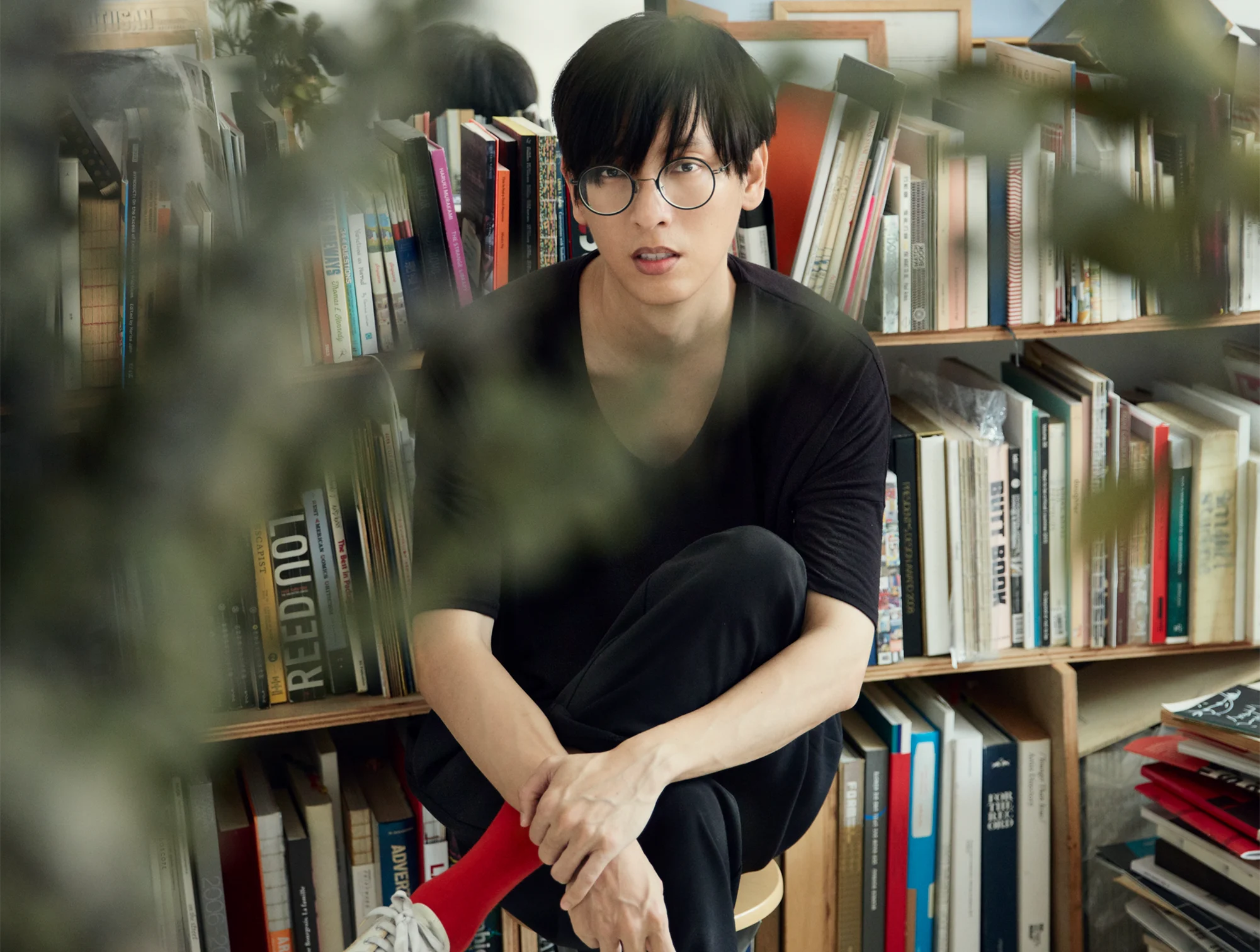
The award-winning designer and researcher on what sets Singaporean design apart, working with air and pressure as design materials, and his (Air) series of everyday objects.


Up next in our Singapore Design in Focus series, we speak with E Ian Siew, a designer, PhD Candidate, and Researcher at the Interactive Materials Lab and the NUS CUTE Center at the National University of Singapore.
His research explores air and atmospheric pressure as design materials, with applications in healthcare innovation. Auxobrace, his final-year project at NUS, was named Singapore’s national winner of the James Dyson Award 2023 and made the award’s global Top 20 shortlist.
Over the course of our interview, he discusses what sets Singapore design apart, why he thinks through making, how he translates principles from material science and engineering into design, how co-design helps him recognize what his own perspective leaves out, and why, while AI can help him get to an experiment, physical making remains essential.
He also talks about Auxobrace, a wearable brace being developed to support recovery after open-heart surgery. The project grew out of his own recovery from a valve replacement in 2021.
He highlights his ongoing (Air) series, which uses everyday objects such as stools and lamps to make the behaviors of air and pressure understandable, and has been shown at Singapore Design Week and Milan Design Week.


I think Singaporean design is shaped by our familiarity with different cultures and ways of thinking. Multiculturalism and bilingualism are part of everyday life here, and our connections with the region and the wider world expose us to both Eastern and Western influences. That gives us many points of reference when approaching a problem.
There is also a resourcefulness that I associate with Singapore. I see it in the willingness to adapt, work within constraints, and find another way when something is not immediately available. That attitude influences how we design as much as the resources we have access to.
Multiculturalism and bilingualism are part of everyday life here, and our connections with the region and the wider world expose us to both Eastern and Western influences.
Our interest in technology and innovation extends into services and the ways we organise everyday life. For me, what makes Singaporean design distinctive is how these cultural influences and practical attitudes come together. Different designers express that in very different ways, which is part of what makes the works interesting.
I think design has always been part of Singapore’s transformation, even when it was not explicitly described that way. In many respects, I see Singapore as a nation by design. The deliberate planning of how we live, move, and access services reflects a designerly way of thinking about constraints and how different parts of a system fit together.
What seems to be changing is the recognition of design as a discipline that can contribute earlier in a conversation. Designers can help define the problem, understand people’s experiences, and explore alternatives before a direction is fixed.
The deliberate planning of how we live, move, and access services reflects a designerly way of thinking about constraints and how different parts of a system fit together.
In my own work, I see the value of that approach in healthcare and research. A design perspective can connect technical possibilities with the everyday experience of the person using them. I hope that as design’s role continues to expand, there will also be more room for experimentation and for contributions whose value takes time to become clear.
The decision grew out of a project that was deeply personal to me. I had worked in industrial design consultancies and enjoyed developing objects, solutions, and services. During my undergraduate studies at NUS, however, my own experience of recovery gave me a particular problem I wanted to stay with.
I have undergone open-heart surgery twice, first as an infant and again in 2021 for a valve replacement. During the second recovery, I became very aware of how much everyday movement involved my chest. While my sternum was healing, small actions that I would normally take for granted could be painful and difficult.
My research now explores air and atmospheric pressure as design materials, including their potential for compressive rehabilitation and the fabrication of airtight textile structures.
That experience became the starting point for my final-year project, Auxobrace, a wearable brace being developed to support recovery after open-heart surgery. The project brought me into contact with soft robotics, wearable technology, and healthcare. I became increasingly interested in the material research behind the materials and in the questions that remained beyond the final prototype.
Pursuing a PhD gave me the time to continue that work. My research now explores air and atmospheric pressure as design materials, including their potential for compressive rehabilitation and the fabrication of airtight textile structures. I am interested in how controlling pressure can change an object’s shape, stiffness, or function, and how designers can work with those behaviors.
What I value about this path is being able to move between practical needs and open-ended experiments. Developing an artifact can address a specific situation while also producing knowledge that other designers might build on.
I am a very hands-on person. Sometimes I begin making before I can fully explain what I am looking for, because handling a material or building a mechanism helps me understand the question. I sometimes think my brain is in my hands.
That is what draws me to thinking through making. A prototype that behaves unexpectedly can be useful if I take the time to understand why. In my work with air, for example, a change in the way a textile is sealed or an internal structure is arranged can lead to a very different movement. Making gives me something concrete to observe, question, and develop.
I am also drawn to principles from material science and engineering. As a designer, I may first encounter them through a paper or a demonstration, then try to understand them through small experiments. Translating a principle into a different material or context can raise questions that the original work was not intended to address. That requires curiosity, but also care in understanding what the principle actually does.
Co-design helps me recognize what my own perspective leaves out. With Auxobrace, my experience of recovery gives me a starting point, while working with clinical professionals helps me question assumptions about support, comfort, and use. I see making and collaboration as closely connected: prototypes give us something to discuss, and those conversations shape what I make next.


I like having a clear sense of purpose, with enough room to discover how to get there. If every detail is decided at the beginning, it becomes harder to follow an unexpected material behavior or question an assumption in the brief.
The balance changes over the course of a project. Early on, creative freedom gives me space to try things and understand what is worth pursuing. As the work develops, clarity becomes more important. I need to decide which ideas serve the project, what needs to be tested, and what can realistically be delivered.
If every detail is decided at the beginning, it becomes harder to follow an unexpected material behavior or question an assumption in the brief.
That balance matters in research because there is always another experiment I could do. Deadlines and research goals help me bring the work into focus. I want enough freedom to be surprised, and enough direction to turn that surprise into something I can explain and share.
I see AI as another tool and material that designers can learn to work with. I am interested in what it allows us to attempt, particularly when an idea involves skills outside our immediate training.
In my own workflow, that includes help with coding, working through parametric modeling logic, and developing small tools that support a project. It can make it easier to begin exploring an unfamiliar process, although I still need to understand and test what comes out of it.
A convincing explanation on screen does not tell me how a textile will seal or how a structure will behave under pressure. AI can help me get to an experiment, but the experiment still has something to teach me.
The part I find especially useful is using AI to make tools that help people make the work. A designer might have a very specific way they want to explore a form, document an experiment, or interact with a material. Being able to build a tool around that process can expand what they are able to do.
For a practice like mine, physical making remains essential. A convincing explanation on screen does not tell me how a textile will seal or how a structure will behave under pressure. AI can help me get to an experiment, but the experiment still has something to teach me.
Alongside Auxobrace, my ongoing “(Air)” series is especially meaningful to me. It grew from an interest in the behaviors I was encountering through my research and a desire to explore them through familiar objects, such as stools and lamps. These works have been shown at Singapore Design Week and Milan Design Week.
In (Air)ssembly, inflation becomes a way of joining parts together. As an inflatable element expands against the surrounding rigid components, it creates the friction that holds the stool’s structure together. Air is necessary to its assembly and its ability to function as a stool.
(Air)just develops that idea through an adjustable lamp. Releasing pressure allows its components to be repositioned; reinflating it locks them in place. The adjustment comes directly from changing the relationship between the inflatable body and the rigid parts around it.
Lumin(Air), which was presented at Milan Design Week 2025, explores vacuum through a wall light. As air is withdrawn from a sealed enclosure, atmospheric pressure compresses the internal structure, causing it to change shape and reveal light beneath. The geometry guides the movement and changes how the light emerges.
I enjoy using everyday objects to make these behaviors understandable. Most people already know what a stool or lamp is supposed to do, so they can notice when its assembly or movement works differently. The names are playful clues to those actions. For me, the series creates a way to share material research through objects people can relate to, while leaving room for curiosity and interpretation.
I would suggest spending time in a hawker center and looking beyond the food. Watch how stallholders arrange their tools and work within a small space, and how customers navigate the shared environment. Those everyday adaptations say a lot about the resourcefulness I associate with Singaporean design.
Andy Yeo, who practices the traditional craft of lacquer threading. His collaboration with Melvin Ong and Shervon Ong was presented at Prototype Island during Milan Design Week 2026, where I was an assistant curator. I am inspired by the care involved in keeping a craft alive while finding ways for it to evolve and be experienced by another generation.
Chinatown. I enjoy the contrast between people who know the neighborhood intimately and visitors finding their way around it for the first time. I am also drawn to in-between spaces, such as MRT stations and bus stops. There is something oddly calming about watching people move through their everyday routines.


To learn more, visit eiansiew.design
All images provided by E Ian Siew